AI Gave Everyone CliffsNotes. The Examiner Read the Book.
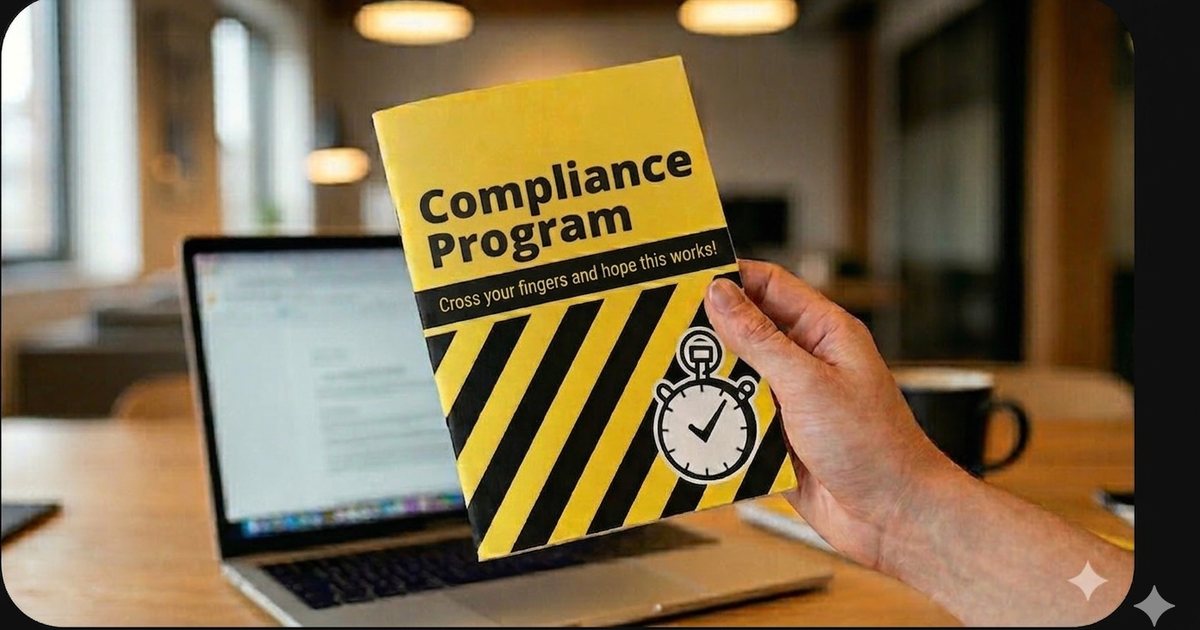
Most of us have depended on them at some point. Cliff’s Notes. That little yellow and black booklet that compressed three hundred pages of plot, theme, and character analysis into a thirty-page summary you could read the evening before the test. Accurate. Efficient. However the summary was not the book. The teacher who assigned the book understood the difference, and the question they asked on the final was designed to find that gap. Students who had read the Cliff’s Notes gave an answer that was close, plausible, and clearly built from somebody else's understanding rather than their own. The teacher could spot it immediately.
The same dynamic is playing out right now in start-up compliance, at substantially higher stakes than your high school English grade. Companies are submitting governance programs, model risk frameworks, vendor diligence packages, and policy libraries that read like that summary. Accurate, efficient, but it’s not the work. The people whose job is to evaluate those artifacts understand the difference. The question they ask on the final is designed to find the gap.
Reviewers Read The Pattern Of The Answer, Not Just The Answer.
The Cliff Notes plan fails the moment someone asks a question that requires underlying understanding. The teacher asks why a particular character makes a particular choice in chapter eleven. The Cliff’s Notes would mention the choice but not the reason, the student improvises something internally consistent, and the teacher does not need a template. The pattern of the answer reveals where the student got their material. The same pattern shows up in fintech compliance whenever a reviewer asks a question that requires the program to have been built, not summarized.
There is a story founders tell themselves about reviews. The story is that reviewers grade against a checklist. That a sufficiently complete artifact answers said checklist, and that the checklist is the test. That story is a fairy tale. Reviewers are not grading your artifacts. They are reading the pattern of how the artifact was produced and the pattern of how the program is operated against it.
The patterns are not subtle. The artifact has all of the right terminology but uses terms in the abstract rather than the specific. The risk assessment lists every category a risk assessment is supposed to list and does not weigh any of them differently. A policy claims a cadence the program does not maintain. The model inventory lists vendors but not the models the vendors actually run. The governance minutes reference decisions but not the alternatives considered or the votes that were taken. Each of these is the textual equivalent of the student who watched the movie. The reviewer notices.
Once the gap is established, the rest of the review is not an evaluation of the program. It is a calibration of how much of what the reviewer has already seen they need to flag. The grade is largely set by the time the second question gets asked. Everything after that is documenting why.
AI Made The Summaries Free. That Is The Problem.
Two years ago a thin program at least cost money to fake. The full policy library meant a consultant's quarter of fees or your own quarter of writing, and the price was the signal. A complete artifact set meant somebody had sat with the material long enough to produce it.
That signal is gone. Any founder with a foundation model subscription can generate the entire library in a weekend, and the output is accurate, current, internally consistent, and formatted better than the consultant's version. Which means every program in the exam queue now submits the same beautiful book report. When every artifact is well written, well written artifacts stop carrying information. The examiner's response is not to read the documents more carefully. It is to discount the documents almost entirely and move the examination to the only thing that cannot be generated: the specific judgments the program made in the last ninety days, and the trail those judgments left behind.
The purest version of the problem is the AI governance policy itself. A model-generated document about governing models, describing a committee that has never met, citing a review cadence no calendar has ever held. The examiner who finds that document is not finding a gap. They are finding the whole posture.
AI did not lower the bar. It moved the bar off the document and onto you.
The Question Is Designed To Be Unanswerable From Summaries.
The question is rarely a trick. The question is usually a request for the specific judgment that produced the artifact. Walk me through the risk assessment for the most recent product change and tell me which risks moved and why. Show me a control test that was performed in the last sixty days and tell me what the result was and what you did about it. Show me a SAR narrative that was returned for revision and tell me what the reviewer asked for and what was changed. Show me a vendor diligence pack that produced a no-go decision and walk me through the reasoning.
Each of those questions is impossible to answer from a generated summary, because the answer requires a specific instance the program actually produced. A summary has categories of instances the program claims to produce, not the instances themselves. The founder or the compliance leader who tries to answer from summary is the student answering in the abstract because they did not read the chapter. The room knows.
The Cost Of Being Caught Is Not An English Grade.
In high school the cost of being caught with CliffsNotes was a C minus and a quiet conversation, contained to the student and the assignment. In fintech compliance the cost is materially worse and the audience for the failure is materially larger.
A sponsor bank reviewer who concludes the program was summarized rather than built does not publish a list. The reviewer files a report internally, the bank's relationship team adjusts their posture toward the fintech, and the next conversation is about remediation timelines rather than partnership growth. A regulator who reaches the same conclusion documents the finding in a formal letter that the company will be answering for years. An acquirer who reaches the same conclusion does not name the conclusion at all. The acquirer simply prices the perceived risk into the offer, which the founder experiences as a discount they did not expect and cannot retroactively negotiate against. In every case the real cost is not the grade on the assignment. It is that the institution re-grades every subsequent interaction.
Reading The Book Is The Same Whether You Did It Before Or Not.
The fix is the one the student who skipped the reading eventually reached. Read the book. Late is not as good as on time, but it is meaningfully better than continuing to answer from Cliff’s Notes.
Reading the book, in this context, is the operational work the Notes were designed to skip. Document the specific decisions the program made in the last ninety days and the reasoning behind each. Populate the governance minutes with attendance and decisions and votes, in real time. Generate the artifacts the program would produce if it were being operated, by operating it. None of this is glamorous. All of it is the difference between an artifact that exists and an understanding that can answer a question on demand.
I Use the Cliff’s Notes Machine Every Day.
I want to be clear about something. I use these tools on the daily (thank you, Claude for helping me teach my son to hit a baseball). They are the best Cliff’s Notes machines ever built. They will draft a policy in minutes. They will reformat a risk register before lunch. What they cannot do is sit in your risk committee, decline the merchant that looked fine on paper and felt wrong in the data, or remember why you tuned the rule in March when the examiner asks in November. The model can write the minutes. It cannot attend the meeting.
The teams using these tools well have understood the direction of generation. They operate the program and use the machine to summarize work that actually happened, which is leverage. The teams about to have a bad examination cycle are generating evidence of work that did not happen, which is the precise thing the person across the table is trained to find. Same tool. Opposite postures. The artifact looks identical on the day it is filed and entirely different on the day somebody asks a question about chapter eleven.
The Teacher Always Knew. The Examiner Always Knows.
There is a quiet truth from the schoolroom that carries straight into the compliance review. The teacher always knew. The students who used the Cliff’s Notes thought they were getting away with something, and they were not. The grade reflected the work, not the artifact.
The examiner is the same teacher with a different syllabus and substantially more authority. The founders and compliance leaders who internalize this early stop trying to optimize the artifact and start operating the function. The artifact then takes care of itself, because an operating function produces its artifacts as a byproduct of being operated. If you did not read the book, do not expect an A. If you did, stop worrying about the grade. The work is the work. The examiner can tell.
The medium varies. The work is the same.